JANE SHORT: THE FORGOTTEN SUFFRAGETTE
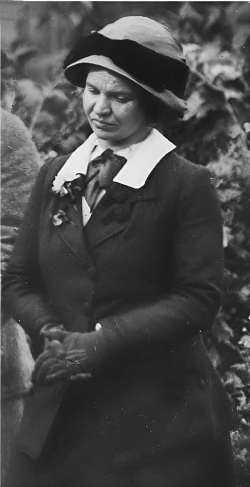
Jane Short alias Rachel Peace (1881–1964) was a militant suffragette and member of the Women's Social and Political Union. Between November 1911 and October 1913 she was arrested three times for window-smashing and once for arson. Imprisoned in Holloway four times (for seven days, three months, five-and-a-half months, and finally ten months) she served a total of nineteen months - longer than any other suffragette.
Early life to 1911
Jane was born Florence Jane Short on 25th April 1881 at 3 Lewis Grove, Catford, London. She grew up at nearby 20 Jutland Road then 18 Willow Walk. Although her father Samuel Short was a manual worker for Lewisham Council, he and her mother Mary, nee Brown, ensured their children received a good education. All three of Jane's siblings entered middle-class professions. Her elder sister trained as a hospital nurse; her two brothers pursued careers in the Civil Service and insurance. Jane initially worked as a shirt machinist but by the age of 30 she was a self-employed embroideress and also a trained massage therapist. Her hobbies included astrology and Esperanto, and she cared deeply about the sexual and economic exploitation of poor women.
As Jane turned thirty, in the spring of 1911, she was lodging at 126 Wilbury Road in the newly-created Letchworth Garden City. Her landlady, Kate Hayward, had moved there in 1907 after her elder sister Edith married the town’s founder (later, Sir) Ebenezer Howard. The Howards lived diagonally opposite Kate and, like Jane, were Esperanto enthusiasts. Edith was a member of the NUWSS and from 1912 Ebenezer was president of the local branch of the Men’s League for Women’s Suffrage. The Suffragette published two full-page articles by him explaining how communal housekeeping could liberate women from domestic chores. Whilst Jane aligned with the Howards, she may have clashed with her fellow lodger Charles Purdom. As Howard’s close associate, he was the town’s planner, finance director and estate manager, and also the historian of the garden city movement. Whilst living with Kate and Jane he publicly aired his reservations about female suffrage and produced a pantomime satirising its adherents. By mid-1912 both he and Jane had left the house.
Letchworth was home to hundreds of suffragists, divided into several societies. At least two served a stretch in prison, and Sarah Carwin and Millie Price had several pro-suffrage letters published in the local paper. Mrs Price, née Browne, had been an activist and speaker for the WSPU since 1907.
First conviction
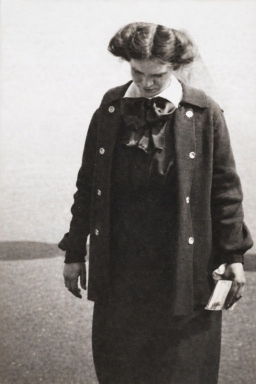
On 21st November 1911 Jane took part in an organised window-smashing raid in central London, protesting against the proposed Manhood Suffrage Bill. She was one of 223 arrested, including Lady Constance Lytton and sisters Emmeline Pethick-Lawrence and Dr Marie Pethick. At Bow Street, charged with breaking windows at the War Office, Jane refused to pay the fine (10s plus 5s damages) and, in default, was sentenced to seven days’ imprisonment.
For the next seven months Jane’s name was absent from the press. During this period two crimes were committed which she may have carried out. On 27th June 1912 a woman brandishing a hammer smashed several windows at Hitchin Post Office. The postmaster saw her running away and called the police, who merely escorted her out of town because the postmaster declined to press charges. Later that night windows were broken at Baldock and Letchworth post offices, the perpetrator escaping unseen. At the time Jane was living at 1 Leys Avenue, facing Letchworth station, but she was not the only window-smasher in town. Sarah Carwin had twice been convicted of the offence (once breaking eleven windows before being stopped). Months later Florence Hull (alias ‘Mary Gray’), one time secretary of the local WSPU, would break windows at the Colonial Office and serve a fortnight in Holloway.
Second conviction
Soon after the post office windows at Baldock were repaired, they were smashed again. At 11.20 pm on 11th July the postmaster saw a woman hurrying towards Baldock station, gave chase and detained her until a policeman arrived. It was Jane, carrying a satchel containing three stones, overnight requisites and embroidery materials.
Her initial hearing at Hitchin Police Court was well attended. Charged with maliciously damaging windows valued at £5 5s, she reserved her defence until her trial at the next Quarter Sessions, almost three months later. Bail was allowed on condition of a surety of £25 from herself and £20 each from local residents Fred Goodliffe (husband of May, secretary of the local WSPU) and Dr Marie Pethick.
At the Quarter Sessions at Hertford on 14th October the magistrates included the pro-suffrage Earl of Lytton, brother of Lady Constance. Jane became the first suffragette to be tried for a crime in Hertfordshire. As some 300 supporters gathered outside the court, Jane stood in the dock proudly wearing the WSPU colours. After pleading guilty she calmly read out a prepared statement explaining that she had broken the windows to impress upon the government the necessity of granting women the vote, which they wanted in order to put an end to the grievances suffered by the female sex. She then launched into a brief history of the suffrage movement, despite being told that the bench did not wish to hear it.
The magistrates offered to discharge Jane if she would promise not to reoffend, but she refused and was sentenced to three months. She was the first suffragette placed in the First Division, which was reserved for political offenders.
Jane’s mother died at the family home on 25th October. It is not known whether she was informed; indeed there is no evidence that she had any contact with her family, in or out of prison.
She was one of only five suffragettes who spent Christmas in Holloway, and after serving the full three months she was released on 13th January 1913.
Members of Letchworth WSPU welcomed Jane home with a celebration held in a local restaurant on 24th January. After being presented with a bouquet she described life in prison:
The doctors and wardresses were most kind, the cell was scrupulously clean and warm, and the food good and plentiful, except the tea, which she could not distinguish from cocoa. At first she was allowed only twenty minutes’ exercise per day, but after threatening to write to [Home Secretary] Mr McKenna she was granted an hour in the morning and an hour in the afternoon…. She was allowed to write one letter per fortnight, on a single sheet of paper, and to receive one… She refused to do prison work on principle, although it would have earned a fortnight’s remission of her sentence.
To her delight a plethora of postcards bearing messages of support arrived from Esperantists in Spain, France, Japan, Germany, Holland and Russia.
Third conviction
A week later, at 6.30 pm on 1st February 1913, Jane hurled pieces of fire-brick through three of the costly plate-glass windows of Hampton & Son, a classy furniture store adjacent to the National Gallery. When arrested she gave her address as Commerce Avenue, Letchworth, and was taken to Vine Street police station, where she was put into ‘a most filthy-smelling cell, without any ventilation’. There was a plank on which to sleep, and ‘an uncovered sanitary arrangement’. She was given ‘a hard, dirty pillow and a rug’.
In the dock at Bow Street Police Court, sporting a hat trimmed in suffragette colours, Jane proclaimed: ‘I recognise neither the Government nor its laws, and what I have done I shall do again.’ When told that she had caused £75 of damage she promised: ‘It will be £175 on the next occasion’. As a repeat offender she was held on remand until 21st February. After her case was heard at Clerkenwell Sessions she addressed the jury:
I have calmly and deliberately committed this offence against the law, in protest against the Government’s recent broken pledge to women. The attacks of those who criticise us through the Press, saying we are hysterical, self-seeking women, doing these things for notoriety and self-advertisement, are utterly false… We want the vote, not for ourselves but for others — for our fellow-sisters struggling in wretched poverty and … for the sweated workers [and] for those women who… are forced to sell themselves, body and soul, to gain even the barest necessities of life… Until women are enfranchised I refuse to recognise the law, and what I have done I shall do again and again until women are fully admitted to their right of citizenship.
The magistrate sentenced her to six months in the Second Division.
After the introduction of the Cat and Mouse Act in late April, any woman who could endure prolonged hunger could secure temporary release. Jane again pushed herself, but had to give up because she felt on the brink of insanity. Released a month early, on 18th July, she thanked those who had sent in books and food during her imprisonment.
On 13th August Letchworth WSPU held a ‘hearty welcome home’ garden party for Jane at 117 Wilbury Road. After music and refreshments Jane gave an account of her time in Holloway, and the event concluded with a resolution condemning the government and demanding the immediate repeal of the Cat and Mouse Act.
Fourth conviction: The Elms
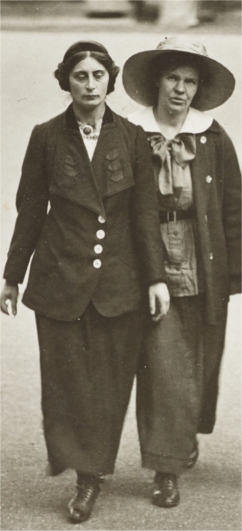
Jane Short’s final crime was the most serious. In the early hours of 4th October 1913 she and Mary Richardson set fire to The Elms, a twenty-three-roomed, three-hundred-year-old mansion in Hampton-on-Thames. The owner, the Countess of Carlisle, was a suffragist, but a critic of militancy. Her final tenant, Dr Thomas Tristram, was Chancellor of the Diocese of London. His daughter Flora left her parents in 1909 to move to Hastings. Dr Tristram died in 1912 and, after his widow moved out, the house lay empty until its destruction.
Jane and Mary were strangers to the area. Although the night was pitch-black and the house hidden by thick fog, they immediately identified the correct boundary fence. Moreover, their activity once inside suggests prior knowledge of the layout. It is therefore noteworthy that former resident Flora Tristram was a militant suffragette and the organiser of Hastings WSPU branch.
The alarm was raised at 3 am. When the fire brigade arrived the house was beyond hope. The blaze was brought under control, but the ancient timber smouldered for the rest of the day. Police found a can half-full of paraffin, an empty bottle of methylated spirits and a container of benzene, the slogan ‘Votes for Woman’ chalked on an inside wall and a copy of The Suffragette bearing the scribbled message: ‘The Government incites us to do this.’
Having escaped via a rear window, Jane and Mary had meandered in the darkness and fog until they ended up almost back where they started. A policeman found them at 3.45 am, boots and skirts covered in wet mud and clothing torn. Jane said her name was ‘Rachel Peace’ and they had missed the last tram back to London. The policeman walked with them to Teddington police station, where they were given cups of hot tea and a welcome rest.
Detectives found shreds of fabric — one of serge, the other rubberised material — on the barbed wire boundary fence. When shown a fragment torn from her raincoat, Jane quipped cockily: ‘I hope you will save it; I shall want to darn it in.’ She and Mary made several more remarks that amounted to a confession. They were remanded in custody.
The police soon discovered Jane’s real identity and previous convictions; however, her alias, ‘Rachel Peace’, was thereafter used in suffrage circles and in the press (although her local paper continued to use her real name).
On 6th October the pair appeared at Teddington police court. The gallery was filled with spectators, suffragettes, reporters and angry locals. When Jane’s remark about darning her coat was read out loud the courtroom rippled with laughter, both defendants joining in. The damage they caused was estimated at £1,500. Had the flames spread, one witness explained, they may have killed a bedridden lady who lived right next door.
Because Mary was a ‘mouse’ out of prison on licence, she was refused bail. Jane was offered bail if she would provide her home address and undertake not to reoffend. She declined, and so both were remanded and sent to Holloway to await trial. They immediately went on hunger strike and became the first suffragettes to be forcibly fed since the introduction of the Cat and Mouse Act, and the first ever to be force-fed whilst on remand.
Whilst Mary was released with appendicitis on 25th October, Jane remained in prison and was forcibly fed three times a day. ‘I feel as if I should go mad. I have had nervous breakdowns before and I now have the sensation of an impending crisis… I have frightful dreams and am struggling with mad people half the night.’ In order to be mentally fit to face her trial, she resumed eating.
At the Old Bailey on 15th November Jane was tried alone, supported by about forty suffragettes in the public gallery. She pleaded not guilty and, after the case against her had been presented, embarked upon a lengthy statement in a voice so weak the judge was unable to hear it. Ignoring the arson charge she spoke only of her six weeks in prison, the ‘horrible torture’ of forcible feeding and the ‘mental anguish and almost intolerable nervous strain’ it caused. She had been treated ‘with the greatest injustice’ and ‘rendered unfit’ to prepare her defence. A voice from the gallery yelled: ‘She is not fit to be tried!’ A pane of plate glass at the back of the dock was shattered by a blow from a hammer, which was then hurled at the judge, striking a prison warder on the forehead. Rotten tomatoes flew through the air, one struck a barrister and burst, spattering his gown. As the culprits were ejected one broke four panes of glass in the door. In the melee four suffragettes were arrested.
The judge summed up and, without leaving the court to deliberate, the jury quickly returned a guilty verdict. Jane made another impassioned speech:
Let me tell you this: I defy Mr McKenna, and I defy the law, and any power on earth, to compel me to serve another long term of imprisonment… I shall resume the hunger strike. If I am forcibly fed again it may soon cause my death, or what is worse, and more likely — drive me mad… Surrender I never shall to the law as it now stands. I consider it my highest duty in life to work in this cause, to give all my time, my efforts, and my life, if need be.
Though he expressed regret, the judge sentenced her to eighteen months with hard labour.
Returned to Holloway, Jane again refused to eat and, two days later, twice-daily force-feeding was commenced. Her throat soon become painfully inflamed from the feeding tube and, after a week, her pulse was ‘dangerously low’. To induce her to eat she was bribed with more books, extra exercise, and coffee ‘for which she has a great weakness’. She stood firm. She was even told that, if she would only undertake not to reoffend, she would be released, but she refused. The Suffragette reported that ‘she sends out a message saying she will endure to the end.’
Release and aftermath
Jane’s prison sentence was due to end in April 1915. No reference to her release has been found in either primary or secondary sources, but it is assumed that she was freed on 10th August 1914 under the general amnesty of suffragette prisoners following the outbreak of the First World War.
After ten months of imprisonment, hunger strikes and forcible feeding, Jane’s health must have been poor. Lady Constance Lytton appears to have felt a personal responsibility towards her. She arranged for her to be cared for in a private mental asylum and, when she was well enough, would invite her to spend a day with her family at Knebworth House.
Although Jane has been described as having no family, this was not the case. Her father remained in Catford until his death in 1924, and her youngest brother lived in nearby Peckham with his wife and daughter until his death in 1944. She also had a sister, another brother, and a large number of cousins.
After Lady Constance’s death in May 1923, Emmeline Pethick-Lawrence suggested that former members of the WSPU might contribute towards Jane’s care, but there is no evidence that this was ever organised. Those who cared for her found her difficult and Mrs Pethick-Lawrence described her as ‘not dangerous but quarrelsome and talkative’.
In 1921 ‘Jane Short alias Rachel Peace’ appears in the census for Buckinghamshire Mental Hospital. By 1939 she was in Wiltshire County Mental Asylum in Devizes, where she died in August 1964, aged 83. She was buried in the grounds of the institution, by then known as Roundway Hospital.
Copyright 2026 Helena Wojtczak
Author of the biography of Mary Raleigh Richardson
→ View book details